Here’s a fact that surprises almost everyone who sits down at our counter with a platinum ring: right now, an ounce of platinum is worth far less than an ounce of gold.
As I write this in late September 2026, gold is around $4,380 an ounce. Platinum is around $1,800. That’s less than half.
Most people grew up thinking of platinum as the premium metal. The more expensive option at the jewelry store. The metal for the “nice” engagement ring. And at retail, platinum rings often still cost more than gold ones, partly because platinum is harder to work with. But as a raw metal, the relationship between the two has flipped, and it’s worth understanding before you sell anything white-colored from your jewelry box.
I’m Larry, owner of Bay Area Gold & Silver Buyers in San Francisco and Houston. I’ve been testing and buying precious metals for close to 20 years. White metals are among the most confusing categories for people because platinum, white gold, palladium, silver, and a few non-precious metals can all look nearly identical. Here’s how to tell them apart and what each is worth.
How platinum and gold swapped places
For much of the 2000s, platinum traded at a premium to gold. It peaked above $2,000 an ounce in 2008, when gold was well under $1,000. Then the two crossed over in the mid-2010s. Gold kept climbing, and platinum didn’t keep up. Over the past few years, gold has gone on an enormous run, while platinum has moved much more modestly.
Platinum has had a decent year, to be fair. It’s up roughly 27 percent from a year ago. But it started 2026 at around $2,200 per ounce and has since come down. Gold, even after pulling back from its January high, is still more than twice the price of platinum.
What that means for your jewelry: per gram, gold is worth more than platinum right now. But that’s only half the story, because platinum is much heavier.
What white gold actually is
White gold is gold. It’s yellow gold mixed with white metals, usually palladium, nickel, or silver, to lighten the color. It comes in the same karats as yellow gold: 14K is 58.3% gold, 18K is 75% gold.
Most white gold jewelry is also plated with rhodium, a bright white metal, to give it that crisp, mirror-white finish. Over time, the rhodium wears off, especially on rings, and the metal underneath can look slightly warm or yellowish. That yellowing is a common clue that a ring is white gold, rather than platinum.
White gold is stamped just like yellow gold: 14K, 18K, 585, or 750.
What platinum jewelry is
Platinum jewelry is usually 90 to 95 percent platinum. It’s naturally white, so it doesn’t need plating, and it doesn’t turn yellow as it wears. Instead, it develops a soft, slightly gray satin look over time that some people love and some people have polished away.
Common platinum stamps include PT950, PLAT, 950 PLAT, PT900, and PT850. On some older pieces, you may see “IRIDPLAT,” which means an alloy of platinum and iridium, typically 90 percent platinum.
Don’t forget palladium
Palladium is a close cousin of platinum and gets used in jewelry too, especially in wedding bands. It’s white, it’s lighter than platinum, and it’s usually stamped PD950, PALL, or 950 PD. It’s also a precious metal, currently trading at around $1,330 per ounce, and it’s frequently used in white gold alloys.
Our XRF analyzer will detect palladium immediately, which is useful because many people don’t know they own it.
Clues you can check at home
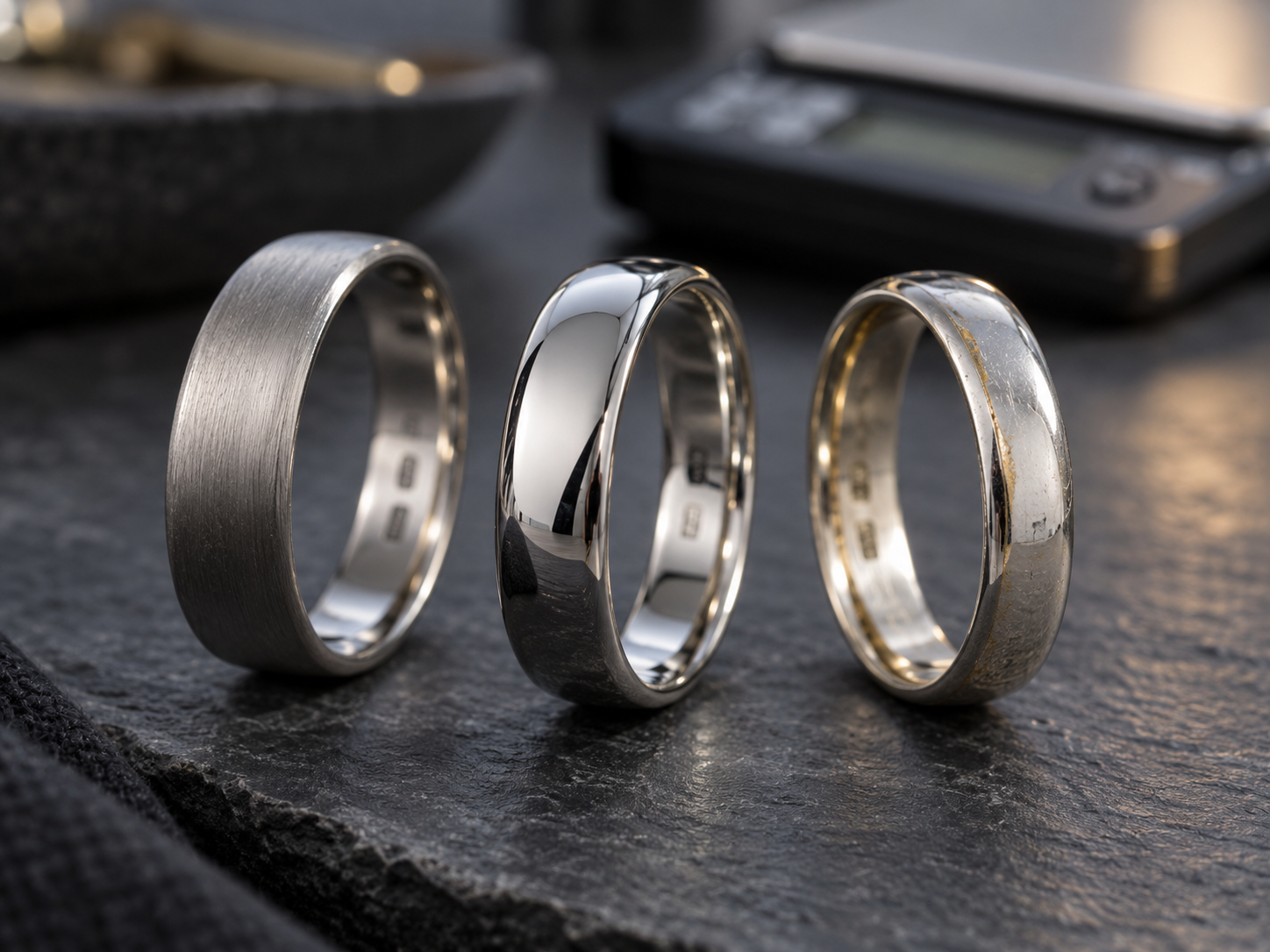
Look at the stamp first. It’s usually on the inside of the band. PT, PLAT, or a platinum number points to platinum. 14K, 18K, 585, or 750 points to gold, white or yellow. PD or PALL points to palladium. “925” or “Sterling” means silver.
Feel the weight. Platinum is dense. It weighs about 21.4 grams per cubic centimeter, compared with roughly 13 grams per cubic centimeter for 14K white gold. A platinum ring feels noticeably heavy for its size. If you have two similar-looking rings and one feels much heavier, that’s a real clue.
Look at the color where it’s worn. White gold that has lost its rhodium plating often shows a faint yellow tint on the underside of the band. Platinum stays gray-white all the way through.
Be careful with the magnet test. Gold and platinum are generally not magnetic, but some platinum alloys that contain cobalt can be slightly magnetic. So a ring that responds a little to a strong magnet isn’t automatically fake. This is one of those cases where home tests can mislead you.
And some white bands aren’t precious at all. Many men’s wedding bands sold in the last 20 years are made of tungsten carbide, titanium, cobalt, or stainless steel. They’re durable, inexpensive, and have essentially no scrap value. They often say what they are on the inside, but not always.
What each metal is worth per gram
Here’s the math at today’s prices. One troy ounce is 31.1 grams.
Platinum at $1,800 an ounce is about $57.90 per gram of pure platinum. A PT950 ring is 95 percent platinum, so its metal is worth about $55 per gram.
Gold at $4,380 an ounce is about $140.80 per gram of pure gold. 14K white gold is worth about $82 per gram. 18K white gold is worth about $105.60 per gram.
So per gram, 14K gold is worth roughly 50 percent more than platinum, and 18K is worth nearly twice as much.
Why platinum isn’t always worth more (but sometimes still is)
Here’s where the density comes back in. Because platinum is much denser, a platinum ring weighs a lot more than the same ring made of gold.
Take a simple wedding band. Say the 14K white gold version weighs 5 grams. The same band in platinum would weigh something like 7.5 grams. At today’s prices:
The 14K band: 5 grams times $82 is about $410.
The platinum band: 7.5 grams × $55 is about $ 412.50.
Almost exactly the same. The extra weight of platinum cancels out its lower price per gram.
Now compare 18K. Say an 18K white gold band weighs 6 grams. The platinum version might weigh about 8.2 grams.
The 18K band: 6 grams times $105.60 is about $634.
The platinum band: 8.2 grams times $55 is about $451.
In that case, the 18K gold ring is worth considerably more than the platinum one.
These are illustrations, and real rings vary. But the takeaway is simple: don’t assume the platinum piece in your jewelry box is the most valuable thing in there. Right now, it often isn’t.
Rings made of two metals
Engagement rings are often made of more than one metal. A very common design is a yellow or white gold band with a platinum head, meaning the part with the prongs that holds the stone. Some older rings have platinum tops on gold shanks.
A good buyer will test each part separately. With the XRF, we can test the band and the head individually and price each metal correctly, instead of guessing or pricing the whole ring as a single item.
What about the diamond?
We no longer buy diamonds. Lab-grown diamonds have changed the resale market so much that I don’t think we can give people fair offers on stones, so we stopped. But the metal in the setting still has its full value. If you have an engagement ring you’re thinking of selling, the platinum or gold in it is worth exactly what the math says it is, and we’ll talk through your options for the stone.
Platinum in older jewelry
If you’re going through an older jewelry box, platinum can turn up where you don’t expect it.
Platinum was very popular in fine jewelry in the early 20th century. Many Edwardian and Art Deco pieces from roughly the 1900s through the 1930s, especially engagement rings with delicate filigree and beaded edges, were made in platinum. Some are unmarked or carry old-style marks, and some combine a platinum top with a gold back.
During World War II, the United States restricted the use of platinum in civilian jewelry because the metal was needed for the war effort. That’s one reason you see a lot more white gold in American jewelry from the 1940s on.
Older pieces with fine hand craftsmanship can sometimes be worth more as antique jewelry than as metal. If we see something like that, we’ll tell you before we talk about melt value.
Why the jewelry store price doesn’t match the metal price
People are sometimes confused to learn that platinum is worth less than gold as metal, because their platinum ring costs more at the store. There are a few reasons.
Platinum is harder to work with. It melts at a much higher temperature than gold and takes specialized tools and skills, so the labor costs more. It’s heavier, so a platinum ring uses more metal by weight. And for years platinum carried a prestige premium at retail that had little to do with the metal price.
When you sell, none of that retail pricing carries over. A buyer pays for the metal inside, at today’s price. That’s true of gold too, but the gap can feel bigger with platinum, because people remember paying extra for it.
Is now a good time to sell platinum?
I can’t tell you where platinum is headed. Nobody can. What I can tell you is where it’s been. Platinum started 2026 at around $2,200 an ounce and is now around $ 1,800. It’s still up roughly 27 percent from a year ago. And it’s well above where it spent most of the late 2010s, when it usually traded somewhere between about $800 and $1,200.
If you have platinum you’re not wearing, it’s worth knowing the number. Whether you sell now or hold is your call.
How we test
At our San Francisco location on Sutter Street and our Houston location on Gessner Road, we use a Niton XRF metal analyzer. It reads the metal’s elemental composition in about 30 seconds without scratching or marking the piece. With white metals, that’s a big deal because acid tests and home tests struggle to reliably distinguish platinum, white gold, palladium, and silver. The XRF doesn’t.
We test on the counter, in front of you. You see the result. Then we weigh each metal group on a calibrated scale, pull up the current spot prices, and walk through the math. If you like the offer, we pay you by check on the spot. If you don’t, you take everything home. No pressure, and yes, get a second quote somewhere else if you’d like. We encourage it.
The short version
Platinum is worth less than half as much as gold per ounce right now. Platinum rings weigh more than gold rings, which narrows the gap. 14K and platinum pieces often come out roughly even, and 18K gold often comes out ahead. Stamps and weight give you clues at home, but white metals are the hardest category to identify without real testing, and many white bands aren’t precious metal at all. When in doubt, get it tested before you decide anything.
Bring your white pieces in and find out exactly what they are. We’re at 780 Sutter Street in San Francisco and 2635 Gessner Road in Houston, Monday through Saturday, 10 AM to 5 PM. Walk-ins welcome. Bring a valid government-issued photo ID.