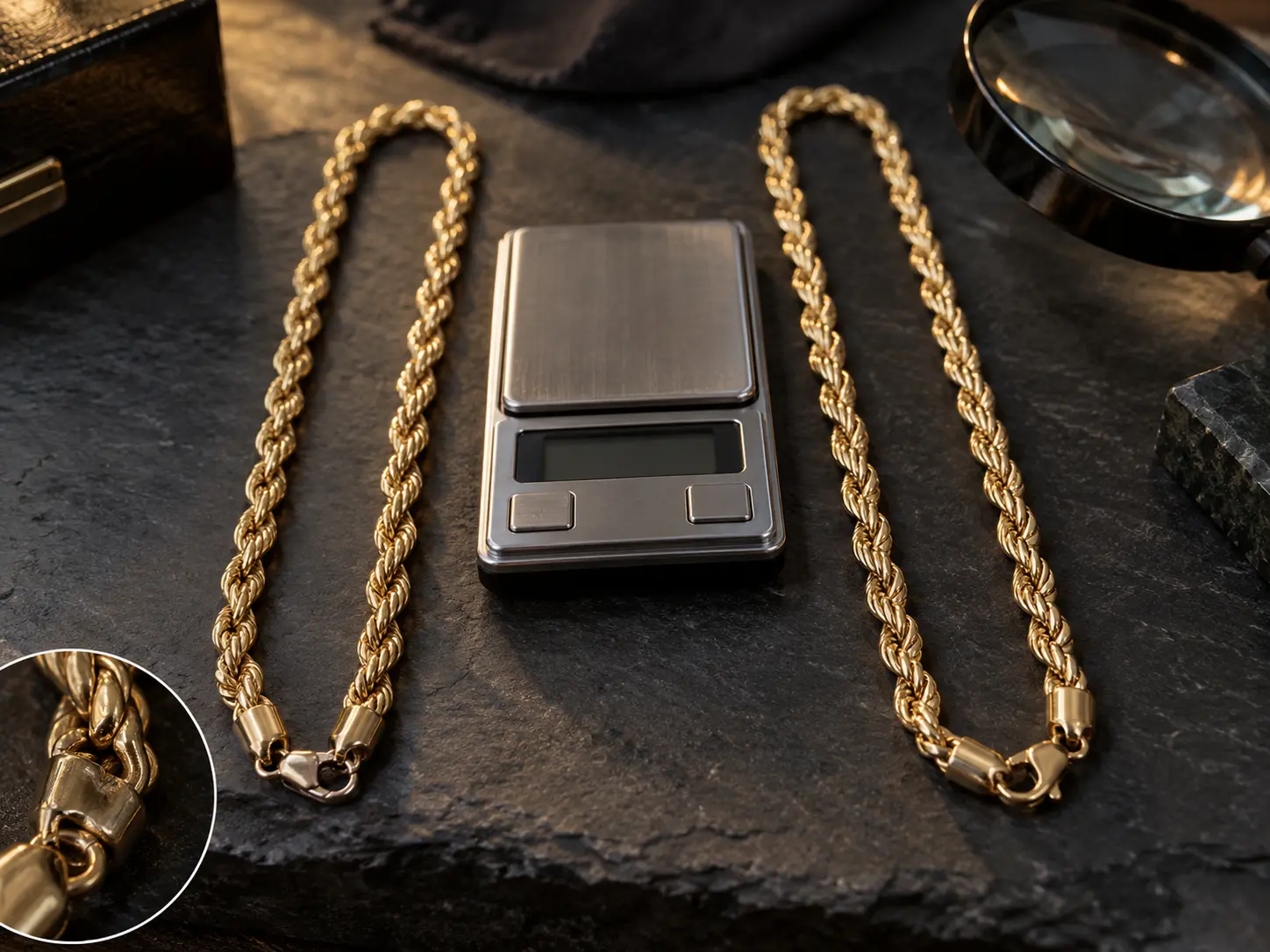
Here’s a situation we see regularly. Someone brings in two gold chains. Same color, roughly the same length, roughly the same thickness. Both stamped 14K. They look like a matched pair.
One of them is worth about three times as much as the other.
The difference isn’t the gold. Both are real 14K. The difference is how much gold is actually in each chain, and that comes down to how the chain was made.
I’m Larry, owner of Bay Area Gold & Silver Buyers in San Francisco and Houston, and I’ve been buying gold for close to 20 years. Chains are one of the most common things people bring us, and they’re also one of the easiest places to misjudge value, in both directions. Here’s how to understand what you have.
Why weight is everything with chains
With gold jewelry, value comes down to three numbers: the karat, the weight, and the gold price that day.
As I write this in October 2026, gold is around $4,190 an ounce. That puts 14K gold at about $79 per gram in gold content, 10K at about $56, and 18K at about $101.
So for any chain, the question isn’t “how big does it look?” It’s “how many grams of gold does it hold?” And two chains that look identical can weigh very different amounts.
Solid chains
A solid chain is made of solid gold wire or links all the way through. Solid chains are heavy for their size, they hold their shape, and they last for decades of daily wear.
Heavy solid chains are some of the most valuable everyday gold items we see. A solid 14K Cuban link chain weighing 100 grams, for example, holds roughly $7,860 in gold at today’s price. Even a modest solid 14K chain at 25 grams holds around $1,960.
Solid chains also sell for their gold whether or not they’re in perfect shape. A snapped solid chain is worth exactly the same per gram as an intact one.
Hollow chains
A hollow chain is made from thin tubes of gold instead of solid wire. From the outside it can look just as bold as a solid chain. Inside, it’s mostly air.
Hollow chains became popular because they let people wear a big, eye-catching chain for a fraction of the price. That’s a perfectly reasonable thing to want. But it also means a hollow chain holds far less gold than a solid chain of the same size.
Here’s an illustration. Picture two 14K rope chains of the same length and width. The solid one weighs 24 grams. The hollow one weighs 7 grams. At today’s price:
The solid chain holds about $1,890 in gold.
The hollow chain holds about $550 in gold.
Same look. Same stamp. A difference of over $1,300.
Those weights are just for illustration. Real chains vary a lot. But the gap is very real, and it’s the number one reason people are surprised when they bring in a chain they thought was worth more.
How to tell if a chain is hollow:
It feels light for its size. If a chunky chain feels surprisingly easy to lift, it may be hollow.
It has dents or kinks. Hollow links crush and dent easily, and once dented, they’re hard to repair. Solid links rarely dent.
Look at the ends. Near the clasp, you can sometimes see that the links or tubes are open or capped.
It may be marked. Some hollow chains are labeled as hollow, but many aren’t.
Please don’t cut a chain open to check. A scale tells you most of what you need to know.
Semi-solid chains are somewhere in between: links that are partly hollow or made with less gold than fully solid ones. They weigh more than hollow chains and less than solid ones of the same look.
Gold-filled chains
This is the one that fools the most people.
A gold-filled chain has a layer of gold bonded over a base metal core, usually brass. By US standards, the gold layer has to make up at least 1/20 of the total weight. It’s much thicker than gold plating, so gold-filled chains can wear well for years and look exactly like solid gold.
The stamp is where people get tripped up. A gold-filled chain is often stamped something like “1/20 14K GF” or “14K GF” or “1/20 12K.” People see “14K” and stop reading.
Here’s what that 1/20 means in practice. A 20-gram chain marked 1/20 14K GF holds about 1 gram of 14K gold. At today’s price, that’s roughly $79 worth of gold, and in practice less of it is recoverable when the chain is refined. Compare that with a 20-gram solid 14K chain, which holds about $1,570.
So always read the whole stamp, including any fractions and the letters GF.
Gold-plated and gold-over-silver chains
Gold-plated chains have a very thin layer of gold on top of base metal. They’re often stamped GP, GEP or HGE (heavy gold electroplate), or carry no gold mark at all. The gold layer is so thin that as metal, these chains are worth next to nothing.
Then there’s a category that looks like gold but is really silver. A lot of chains, especially from Italy, are sterling silver with a gold-colored finish. They’re often stamped 925, sometimes with “Italy.” That 925 means the chain is sterling silver, 92.5 percent silver, not gold. It does have silver value. At around $61 an ounce for silver, sterling is worth about $1.81 per gram. A 20-gram sterling chain holds about $36 in silver. That’s real, but it’s very different from gold.
You’ll also see words like “bonded” or “layered” on some chains sold on TV and online. These usually mean a gold layer over another metal, so read the full stamp and get it tested before assuming anything.
How to read a chain’s stamp
Chains are usually stamped near the clasp, either on the clasp itself or on a small tag next to it. You’ll want a magnifying glass.
Common marks you’ll see:
10K, 14K, 18K, 417, 585, 750: solid gold at that karat (though “solid” here refers to the metal, not the construction, so a hollow chain can still be stamped 14K).
14KP or 14K Plumb: solid 14K gold that meets the karat standard exactly.
GF, 1/20, 1/10, RGP: gold-filled or rolled gold plate.
GP, GEP, HGE: gold-plated.
925, Sterling, Italy 925: sterling silver, sometimes with gold plating.
A star with a number and two letters, like a star, 123 and AR: this is an Italian manufacturer’s mark. The letters identify the province where the chain was made, like AR for Arezzo or VI for Vicenza. It usually appears alongside a fineness number like 750 or 585.
And remember, the clasp and the chain can be marked differently, and sometimes the clasp is the only part that’s marked at all. A stamped clasp doesn’t guarantee the whole chain is the same metal. That’s why testing matters.
Chain styles and what to expect
Different chain styles carry gold differently, and knowing the style helps you guess what you have.
Rope chains are made of small links twisted into a spiral. They come in solid and hollow versions, and hollow ropes are very common.
Cuban and curb chains have flat, interlocking links. Solid Cuban chains are among the heaviest everyday chains we see. Hollow versions exist too, and they look almost identical from a distance.
Box and franco chains use square links. They’re usually solid and feel dense for their width.
Figaro chains alternate short and long links. They’re most often solid, though lighter versions are common.
Herringbone chains are flat and slinky. They’re usually solid but very thin, so they don’t weigh much, and once they kink they’re nearly impossible to straighten. A kinked herringbone is a classic “sell it for the gold” item.
Heavy chains from the 1980s and 1990s deserve a special mention. A lot of them were bought when gold cost a few hundred dollars an ounce, worn for a few years, and then put away. At today’s prices, a solid chain from that era can hold far more value than its owner remembers paying.
White gold and two-tone chains
White gold chains are real gold mixed with white metals and usually plated with rhodium for a bright finish. They’re stamped just like yellow gold, 14K or 585, 18K or 750, and they’re valued the same way. Two-tone chains that mix yellow and white gold are also valued by karat and weight. The color doesn’t change the gold content.
Repair or sell?
If a solid chain breaks at the clasp or a single link, a jeweler can usually fix it for a modest cost, and if you love the chain, that’s worth doing. Hollow chains are different. Dents and crushed links are hard to repair well, and the repair can cost more than it’s worth. If you’re not going to wear a damaged chain again, selling it for its gold is often the practical choice.
The little steel spring
One detail worth knowing: most spring-ring clasps have a tiny steel spring inside. That’s normal, and federal guidelines allow small working parts like springs to be made of other metals. The spring weighs very little, but on a light chain a careful buyer may account for it. It’s not a trick, just physics.
Chains with pendants
If a chain has a pendant, the two are often made separately and can be different karats. The pendant may also have stones, enamel or a hollow back. We test and weigh pendants separately so each part is priced correctly.
Broken, kinked and tangled chains
Broken chains are worth the same per gram as perfect ones. A dented hollow chain that can’t be repaired is still worth its gold. And a hopeless knot of chains you gave up on years ago is worth whatever gold is in it.
Please don’t spend an evening trying to untangle them. We don’t need them separated. We do need to know what metals are in the bundle, which is why we test before we weigh. If you know some of the chains in a knot are plated, mention it.
Estimating your chain’s value at home
Here’s a quick way to get a rough idea before you visit.
Weigh the chain on a kitchen or postal scale set to grams. If your scale only reads ounces, multiply the reading by 28.35 to get grams.
Check the stamp. If it’s GF, GP, or 925, the gold value is small or zero.
If it’s stamped 14K, multiply the grams by about $79. For 10K, multiply by about $56. For 18K, about $101.
That gives you the gold content at today’s price, give or take. It’s not an offer, since any buyer pays a portion of melt value, but it tells you whether you’re looking at $50 or $1,500.
How we evaluate chains
At our San Francisco and Houston locations, we test every chain with a Niton XRF metal analyzer, right on the counter in front of you. It reads the metal in about 30 seconds without scratching anything. With chains, we often test the clasp and the body separately, since they can be different.
Then we weigh each karat group on a calibrated scale that faces you, pull up the current gold price, and show you the math. If you accept, we pay you by check on the spot. If you don’t, you take your chains home. No pressure, and you’re welcome to get a second quote somewhere else.
Before you visit
Bring every chain, including the broken and tangled ones. Read the stamps with a magnifying glass if you’d like, but don’t rely on them. Don’t untangle, cut or clean anything. Bring a valid government-issued photo ID.
We’re at 780 Sutter Street in San Francisco and 2635 Gessner Road in Houston, Monday through Saturday, 10 AM to 5 PM. Walk-ins are welcome, or book online for faster service.
Two chains can look the same and be worth very different amounts. The only way to know which one you have is to weigh it and test it.