A customer once brought a single gold coin into our shop. He wanted to sell it, and he expected to be paid for the gold. That’s how most coin sales go.
But something about it made us look closer. After some research, we found the coin was worth about ten times its gold value to collectors.
That’s not typical. Most gold coins are worth roughly their gold content plus or minus a little. But it happens often enough that anyone selling gold coins should understand the difference between a bullion coin and a collectible one, and should make sure their buyer checks.
I’m Larry, owner of Bay Area Gold & Silver Buyers in San Francisco and Houston. I’ve been buying gold and silver for close to 20 years, and coins are some of the most interesting things that come across the counter. Here’s what you need to know.
Two kinds of value
Every gold coin has a melt value, which is what the gold inside is worth at today’s price.
Some coins also have a numismatic value, which is what collectors will pay because of the coin’s rarity, date, mint mark, condition or history.
For most modern bullion coins, the melt value is most of the story. For older and rarer coins, the numismatic value can be far higher than the gold. The right way to sell is whichever route pays more, and the only way to know is to have someone check both.
Modern bullion coins
Bullion coins are made by government mints mainly as a way to own gold. They’re common, their gold content is guaranteed, and they’re easy to value. As I write this in October 2026, gold is around $4,190 an ounce.
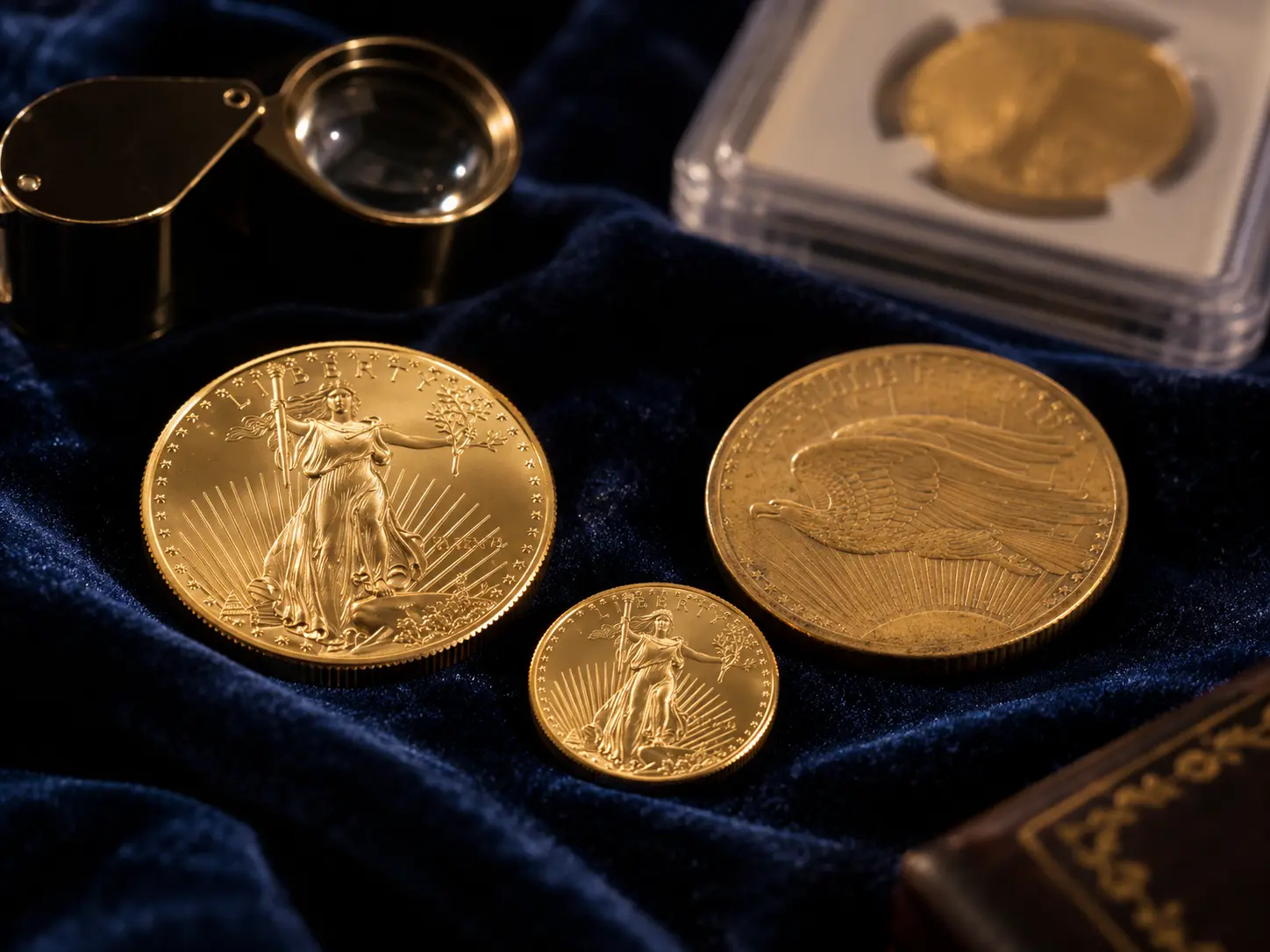
American Gold Eagle. Made by the US Mint since 1986. The one-ounce coin contains exactly one troy ounce of gold, about $4,190 at today’s price. It also comes in half, quarter and tenth-ounce sizes. A one-tenth ounce Eagle holds about $419 in gold.
American Gold Buffalo. A one-ounce coin of 99.99 percent pure gold, made since 2006. About $4,190 in gold.
South African Krugerrand. First made in 1967, and one of the most widely owned gold coins in the world. The one-ounce coin contains one troy ounce of gold.
Canadian Maple Leaf. A one-ounce coin of 99.99 percent pure gold, made since 1979.
Austrian Philharmonic, Chinese Panda, British Britannia and many others are also common bullion coins.
Older foreign gold coins show up too. A British sovereign contains about 0.2354 troy ounces of gold, roughly $986 worth at today’s price. A Mexican 50 pesos coin contains about 1.2057 troy ounces, roughly $5,050.
Why your Gold Eagle weighs more than an ounce
This trips up a lot of people who weigh their coins at home.
The American Gold Eagle and the Krugerrand are made of 22K gold, which is 91.67 percent gold mixed with a little copper and silver to make the coin more durable. So the one-ounce coin actually weighs about 33.93 grams, not 31.1. It still contains exactly one troy ounce of pure gold. The extra weight is the alloy.
The Maple Leaf, Buffalo and Philharmonic are 99.99 percent pure, so their one-ounce coins weigh about 31.1 grams.
If you weigh a Gold Eagle and get about 34 grams, that’s correct. If you weigh it and get 28 grams, something is wrong, and you should have it checked carefully.
Pre-1933 US gold coins
Before 1933, the United States used gold coins as everyday money. These were made of 90 percent gold, and they came in several denominations:
The $20 Double Eagle contains about 0.9675 troy ounces of gold, roughly $4,050 at today’s price. The $10 Eagle contains about 0.48375 ounces, roughly $2,030. The $5 Half Eagle contains about 0.24187 ounces, roughly $1,010. The $2.50 Quarter Eagle contains about 0.12094 ounces, roughly $510. The $1 gold coin contains about 0.04837 ounces, roughly $200.
In April 1933, President Franklin Roosevelt signed Executive Order 6102, which required Americans to turn in most of their gold coins. Huge numbers were melted down. The coins that survived, many of them held overseas, are what collectors buy and sell today.
Because of that history, pre-1933 US gold coins very often sell above their melt value, even in common dates and ordinary condition. Certain dates, mint marks and high-grade examples are worth a great deal more. The most extreme example is the 1933 Double Eagle, a coin that was struck but almost never released. One sold at auction in 2021 for about $18.9 million.
Nobody is going to walk in with one of those. But the point stands: with old US gold, always check the collector value before selling for melt.
Proof coins, sets and certified coins
Proof coins are special collector versions struck with polished dies, giving them a mirror-like finish. They often come in a plastic capsule inside a box with a certificate of authenticity. If you have the original packaging and paperwork, keep it with the coin. Some proof coins carry premiums, some don’t, but the packaging helps either way.
Certified coins are coins that have been graded and sealed in a plastic holder by a grading company such as PCGS or NGC. The holder shows the coin’s grade and a certification number. Don’t remove a coin from its holder. The certification is part of what makes it valuable.
Coins versus bars
Gold bars are even simpler to value than bullion coins. Bars from established refiners are stamped with their weight, purity, the refiner’s name and often a serial number. A one-ounce bar of 99.99 percent gold holds one troy ounce of gold, about $4,190 at today’s price. Bars come in sizes from one gram up to a kilogram and beyond. We still verify the metal and weight, but bars are usually some of the fastest transactions we do.
Gold-layered coins and medallions
Some “coins” sold through TV ads and online stores aren’t gold coins at all. They’re silver or base-metal rounds with a very thin layer of gold on the surface, often described as “clad” or “layered in pure gold.” Others are private medallions or commemorative tokens rather than government-issued coins. The thin gold layer has very little metal value, even though the packaging can look official.
That doesn’t mean they’re worthless. Some are sterling or fine silver underneath, and that silver has value. But it’s worth knowing before you count on them as gold.
US commemorative gold coins
The US Mint has also issued many commemorative gold coins since the 1980s, often in $5 and $10 denominations, celebrating events like the Olympics or historic anniversaries. A $5 commemorative usually contains about 0.24187 troy ounces of gold, roughly $1,010 at today’s price. Most trade close to their gold value, though some with low mintages carry a premium.
Coin jewelry
Gold coins mounted in bezels as pendants, rings or bracelets are common, especially Mexican pesos, sovereigns and small US gold coins. The bezel is often a different karat from the coin, so we test them separately. Removing a coin from a bezel can sometimes leave marks on the coin’s edge, and coins that were worn as jewelry often have wear that lowers collector interest. In many cases, both the coin and the bezel end up being valued for their gold.
Don’t clean your coins
This is the most important advice in this whole post.
Cleaning a coin, even gently, can destroy its collector value. Collectors care a great deal about a coin’s original surface. A coin that’s been rubbed with polish, a cloth or a cleaning solution often shows fine scratches and an unnatural shine that experienced eyes spot immediately. For a bullion coin, cleaning doesn’t change the gold value. For a collectible coin, it can wipe out most of the premium.
Leave your coins exactly as they are. Handle them by the edges if you can.
Counterfeits are real
Popular gold coins are counterfeited, and some fakes are very good. Some are gold-plated base metal. Some use tungsten, a metal with a density very close to gold’s, so the fake has nearly the right weight.
A careful buyer doesn’t rely on any single test. Checking the weight, the diameter and thickness, and the metal itself together catches most problems, because a fake that gets one of those right usually gets another wrong. Experience matters too.
If you bought coins from a reputable dealer, you’re probably fine. If you inherited coins with no history, or bought them online at a price that seemed too good, it’s worth having them checked before you count on their value.
Premiums when buying versus selling
If you’ve bought gold coins, you’ve probably noticed that dealers charge more than the gold price when they sell to you. That extra amount is called a premium, and it covers minting, distribution and the dealer’s margin.
When you sell, you shouldn’t expect to get that premium back. A buyer is generally paying based on the gold content. That’s why the gap between what you paid for a bullion coin and what you can sell it for is largest right after you buy, and why bullion coins tend to make the most sense as a long-term holding.
Collectible coins work differently, since their value comes from the collector market. That’s another reason to have both values checked.
A note on reporting
Most individual gold coin sales don’t trigger any special paperwork from the buyer. Certain large sales do. For example, sales of 25 or more one-ounce Krugerrands, Maple Leafs or Mexican Onzas are among the transactions dealers report to the IRS on Form 1099-B. Whether a form is filed or not, whether you owe tax depends on your gain, not on the paperwork. We covered this in more detail in our article on taxes and selling gold, and a tax professional can advise you on your situation.
How we handle coins
At our San Francisco and Houston locations, we test gold coins with our Niton XRF analyzer, right in front of you, and weigh them on a calibrated scale. We look at what the coin is, its date and condition, and whether it’s likely to be worth more to a collector than its gold.
If we think a coin is worth more as a collectible, we’ll tell you, and we’ll explain where and how you’re likely to get the most for it, even if that means you don’t sell it to us. That’s how we’ve always handled coins, and it’s how we’d want to be treated.
If a coin is valued for its gold, we pull up the current gold price and walk you through the math. If you accept the offer, we pay you by check on the spot. If not, you take your coins home. No pressure, and you’re welcome to get a second opinion.
Before you visit
Bring the coins as they are, uncleaned. Keep proof coins in their capsules and certified coins in their holders. Bring any boxes, certificates or receipts you have. Bring a valid government-issued photo ID, which the law requires for every sale. If you have a large collection, book an appointment online so we can give it proper time.
We’re at 780 Sutter Street in San Francisco and 2635 Gessner Road in Houston, Monday through Saturday, 10 AM to 5 PM.
Most gold coins are worth their gold. A few are worth much more. It takes a few minutes to find out which kind you have, and it’s worth doing before you sell anything.