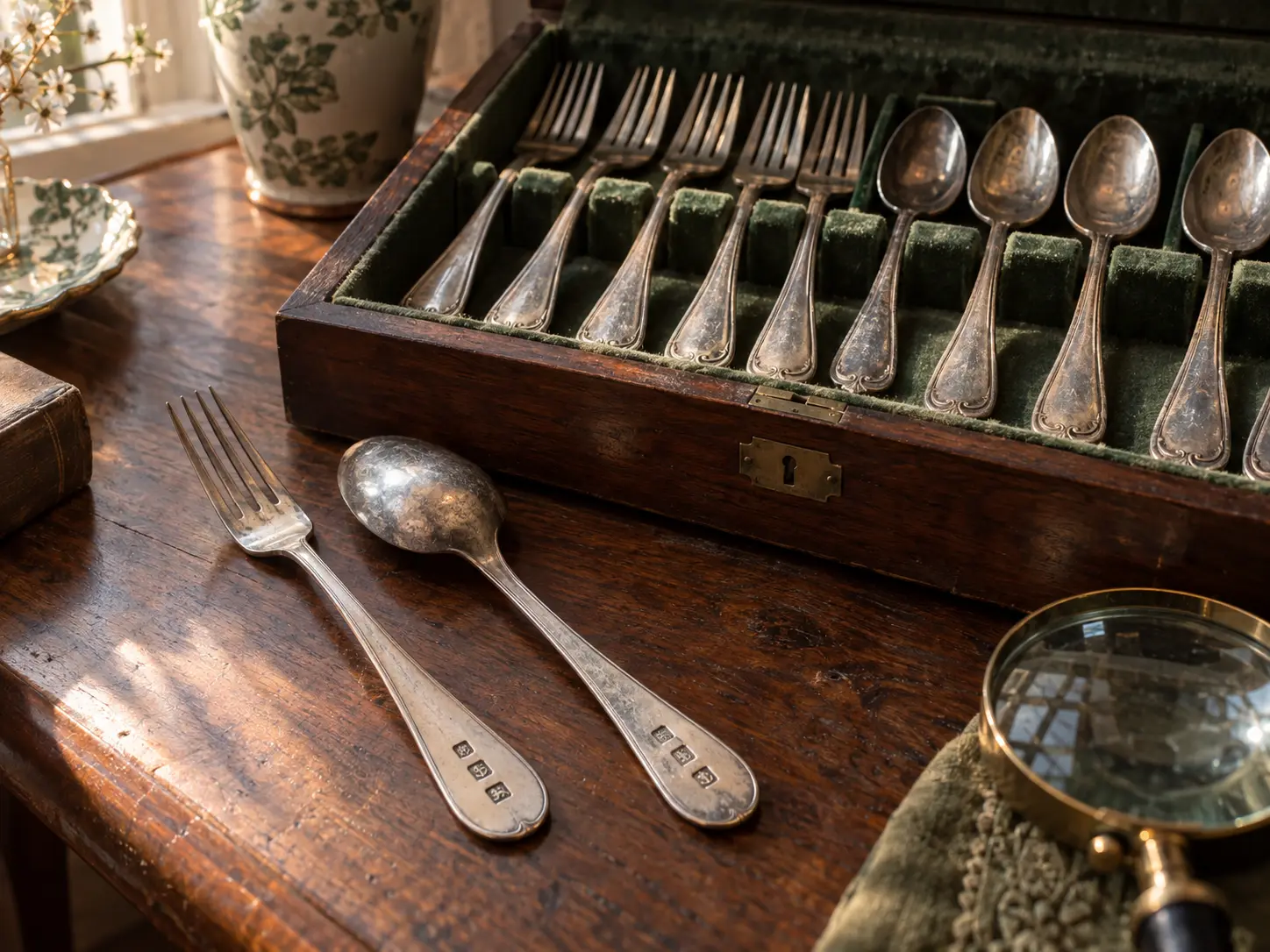
Every fall, a certain kind of question starts showing up at our counter. Someone is getting ready to host Thanksgiving. They open the dining room buffet for the first time in a year, and there it is: the wooden chest with the silverware their mother or grandmother pulled out for every holiday. Nobody has polished it in ages. Half of it is black with tarnish. And the question is always some version of the same thing. “Is this real silver? Is it worth anything?”
Sometimes the honest answer is “not much.” Sometimes it’s “a couple thousand dollars.” The difference usually comes down to one word stamped on the back of the handle, and most people have never looked for it.
I’m Larry. I’ve been buying gold and silver for close to 20 years, and I run Bay Area Gold & Silver Buyers in San Francisco and Houston. Flatware is one of the categories where I see the widest gap between what people expect and what they actually have, in both directions. So here’s how to figure out which camp your set falls into before you drive anywhere.
Why this matters more in 2026 than it used to
Silver has had a wild couple of years. It set a record of about $121 an ounce at the end of January 2026, then fell hard. As I write this in late September, it’s trading around $66 an ounce. That’s roughly half the peak. It’s also about 50 percent higher than it was a year ago, and far above the $15 to $25 range where silver sat for most of the 2010s.
Put simply, a sterling flatware set that was worth a few hundred dollars in silver content ten years ago can be worth well over a thousand today. Silver-plated flatware, on the other hand, is worth about what it always was as metal, which is close to nothing. So the sterling-versus-plated question now has real money on the line.
Sterling and silver-plated are two completely different things
Sterling silver is an alloy that’s 92.5 percent pure silver. The other 7.5 percent is usually copper, which makes the metal hard enough for everyday use. When you hold a sterling fork, you’re holding silver all the way through.
Silver-plated flatware is a base metal with a very thin coat of silver applied to the surface by electroplating. The base is usually brass, copper, or something called nickel silver, which, despite the name, contains no silver at all. A good plated set can look identical to sterling on a holiday table. But the silver layer is so thin that when it’s melted down, the recoverable silver is negligible.
That’s why the stamp matters so much. Two forks can look the same next to a dinner plate and be worth $1 and $80, respectively.
How to read the marks on your flatware
Turn a fork or spoon over and look at the back of the handle, near where it widens. You’ll probably want a magnifying glass and a flashlight. Tarnish can hide marks, so look closely before you decide there’s nothing there.
Marks that usually mean sterling:
“STERLING” spelled out. This is the most common mark on American sterling made in the 20th century.
“925” or “.925,” which means 925 parts per thousand silver.
A small lion walking with one front paw raised, called a lion passant. That’s the traditional British sterling mark, and it usually sits next to a few other tiny symbols for the city and year.
“COIN” or “900” on older American pieces from the 1800s. That’s coin silver, about 90 percent pure. A little less silver than sterling, but still very much worth testing.
Marks that usually mean silver-plated:
“EP,” “EPNS” (electroplated nickel silver), or “EPBM” (electroplated Britannia metal).
“Silver plate,” “Silverplate,” “Triple plate,” “Quadruple plate,” “A1,” or “Plated.”
Brand names associated with plated lines, like “1847 Rogers Bros.” or “Community.” Those companies made plenty of good-quality plated flatware, and people often assume a well-known name means sterling. It doesn’t.
“Nickel silver” or “German silver.” Again, there’s no silver in either one.
Many famous American makers, including Gorham, Wallace, Towle, Reed & Barton, and International, produced both sterling and plated lines. So the maker’s name alone won’t tell you much. The word “Sterling” or the number “925” is what you’re really looking for.
And no mark at all doesn’t prove anything. Some older pieces, handmade pieces, and pieces from Mexico, Latin America, and parts of Asia are unmarked or carry local marks most people won’t recognize. Those simply need to be tested.
The knives are the trap
This is the part that catches almost everyone.
In most American sterling sets, the dinner knives are not solid sterling. The handles are hollow sterling shells, filled with a cement or resin compound for weight and balance, and the blades are stainless steel. The handle really is sterling, and it’s usually stamped that way. But most of what you feel when you pick up the knife is steel and filler.
The same goes for many candlesticks, which are often “weighted” with filler at the base, and for serving pieces with hollow handles, such as cake servers and carving sets.
This matters for two reasons. First, if you weigh your whole set on a kitchen scale and multiply by the price of silver, you’ll badly overestimate what it’s worth. Second, a knowledgeable buyer will separate the knives and hollow pieces from the solid ones. That isn’t a trick. It’s just physics. The silver in a hollow handle is a small fraction of the knife’s weight.
The forks, spoons, and solid serving pieces are where the real silver weight is.
What sterling flatware is worth right now
Here’s the math, the same way we do it at the counter. I’ll use a silver price of $66 per troy ounce, which is roughly where it sits as I write this. Check the current price when you read this, because silver moves a lot more than gold.
One troy ounce is 31.1 grams. At $66 an ounce, pure silver is worth about $2.12 per gram. Sterling is 92.5% silver, so the silver content in sterling is worth about $1.96 per gram.
A sterling dinner fork usually weighs between 40 and 60 grams, depending on the pattern. Heavier patterns weigh more; lighter everyday patterns weigh less. Teaspoons are lighter, often 25 to 35 grams.
Say you have a service for eight: eight dinner forks, eight salad forks, eight teaspoons, and eight soup spoons. That’s 32 solid pieces. If they average 40 grams each, that’s 1,280 grams of sterling.
1,280 grams times $1.96 per gram is about $2,510 in silver content.
Add a few solid serving spoons and a sugar spoon, and the number climbs from there. A service for 12 with serving pieces can easily reach several thousand dollars in silver content at today’s prices.
That’s melt value, meaning the value of the silver itself. No buyer pays 100 percent of melt value, because the metal still has to be refined, and that costs money. But melt value gives you the ceiling against which to measure any offer, and you should always know it before you sell.
Now compare that with a silver-plated set of exactly the same size. The silver on the surface is so thin that the metal value of the whole set is usually a few dollars. Plated sets can still have value as usable flatware or for someone trying to complete a pattern, but as metal, they’re close to worthless. I’d rather you hear that from me before you load the car.
What about tea sets, trays, and bowls?
Silver tea sets, trays, bowls, and pitchers are called hollowware, and the same rules apply. Look for “Sterling” or “925.” A lot of hollowware in American homes is plated, especially large trays and tea services, and plated hollowware is often stamped EPNS or carries a maker’s name with no sterling mark at all.
A few other things to know. Teapots and coffee pots often have handles or insulators made of wood, bone, or composite material. Those parts aren’t silver, so they get subtracted. Some bowls and compotes have weighted bases, like candlesticks. And older British pieces you might see described as “Sheffield plate” are an early form of plating, where silver was fused onto copper. Antique Sheffield plate can have some collector interest, but as metal it’s in the plated category.
Solid sterling hollowware, though, can be heavy. A full sterling tea service can weigh several pounds, and at current silver prices that’s serious money.
When sterling is worth more than its silver
Most sterling flatware ends up being sold for its metal. But some pieces are worth more to people who want to use them.
Certain makers, like Georg Jensen and Tiffany, have collectors who pay above melt for specific patterns. Complete sets in popular patterns sometimes sell for more through pattern-matching services (Replacements, Ltd. in North Carolina is the best-known one) than they would as scrap. Unusual serving pieces, such as fish servers, berry spoons, or pieces with elaborate hand-chased decoration, can also command a premium.
If you bring in a set and I think it’s one of those, I’ll tell you. We’d rather point you to the place that pays more than buy something for less than it’s worth. That’s how we handle collectible coins too. If something is worth more to a collector than it is as metal, you deserve to know before you sell.
For most family sets, though, silver content drives the value, and at today’s prices that’s plenty.
Don’t polish it before you come in
People feel embarrassed bringing in black, tarnished silver. Please don’t. Tarnish is a thin layer of silver sulfide on the surface. It has no effect on the metal value. We weigh and test it exactly as it is.
Polishing takes hours, removes a tiny bit of silver every time, and won’t change the offer. If you’re keeping the set, polish it for the holidays and enjoy it. If you’re thinking about selling, skip it.
Same with monograms. Many older sets are engraved with a family initial. That lowers the value to someone who wants to set a table with it, but it makes zero difference to the silver content.
How we test it
At both our San Francisco location on Sutter Street and our Houston location on Gessner Road, we use a Niton XRF metal analyzer for testing. It reads the metal’s elemental composition in about 30 seconds without scratching or damaging anything. We do it on the counter, in front of you, and you can watch the result on the screen.
That’s especially useful with flatware, because it settles the sterling-versus-plated question on the spot, even for unmarked pieces or foreign marks. Then we separate the solid pieces from the hollow ones, weigh everything on a calibrated scale, pull up the current silver price, and show you the math.
If you like the offer, we pay you by check right there. If you don’t, you pack everything back in the box and take it home. No pressure. And I’d encourage you to get a second quote somewhere else. We say that on our website and we mean it.
Before you visit
Look for “Sterling,” “925,” or a lion mark on the backs of the handles. Set aside anything marked EP, EPNS, Silverplate, or Rogers, since it’s almost certainly plated. Don’t include the knives when you estimate weight at home. Don’t polish anything. Bring a valid government-issued photo ID, as required by law for every sale. If it’s a big set, book an appointment online so we can give it the time it needs.
We’re at 780 Sutter Street in San Francisco and 2635 Gessner Road in Houston, Monday through Saturday, 10 AM to 5 PM. Walk-ins are welcome.
One last thing. If the set is sterling, you use it every Thanksgiving, and you love it, keep it. I mean that. But if it’s been sitting in a buffet for 15 years waiting for a dinner party that never happens, it might be worth finding out what it’s doing in there.