A watch is the one thing we buy where the metal can be the least important part of the price.
With a gold chain, the math is simple. Karat, weight, spot price. With a watch, you’re dealing with two completely separate kinds of value that sometimes point in opposite directions. A stainless steel Rolex has almost no metal value at all and can still be worth thousands of dollars. A heavy 14K gold watch from a brand nobody collects can be worth more melted down than it would ever sell for as a watch.
Knowing which kind of watch you have is the difference between a good sale and a bad one. I’ve been buying precious metals for close to 20 years at Bay Area Gold & Silver Buyers, and we buy luxury watches at both our San Francisco and Houston locations, including Rolex, Cartier, Patek Philippe, and Audemars Piguet. Here’s how I think about them, and how you should too.
The two kinds of value
Every watch has a metal value and a market value.
Metal value is the worth of the precious metal in the case and bracelet if it’s melted. For a gold watch, that’s calculated the same way as any gold item: the karat, the weight of the gold parts, and today’s gold price. The movement, crystal, dial, and any steel parts don’t count toward it.
Market value is what someone would pay for the watch as a watch. That depends on the brand, the specific model and reference number, condition, whether it runs, whether the parts are original, and whether you still have the box and papers. For well-known brands, this number can be many times the metal value.
The right way to sell is whichever number is higher. The mistake people make is assuming they know which one that is.
Most luxury watches aren’t gold
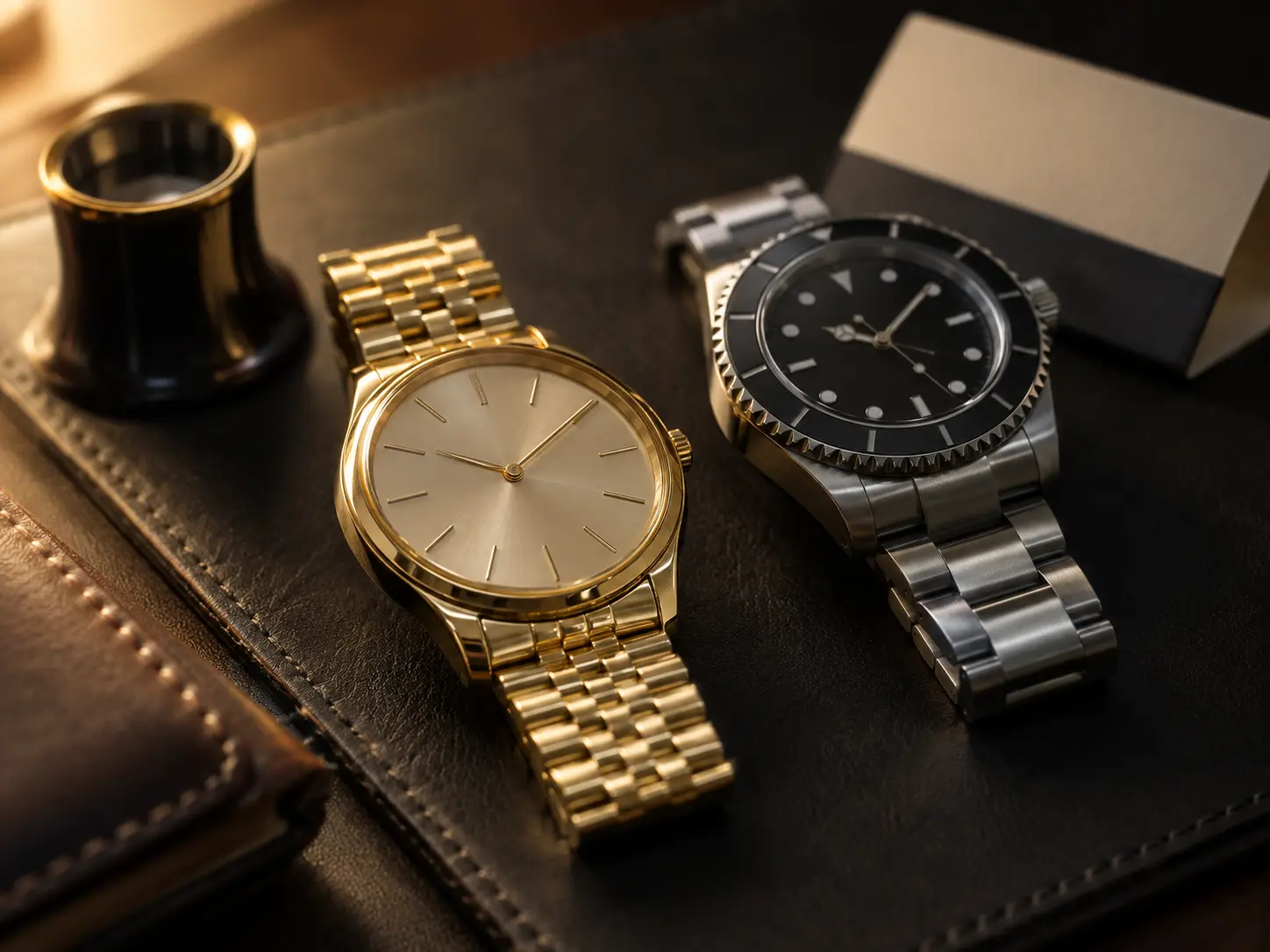
This surprises people. Most of the Rolex watches you see on wrists are stainless steel. The same is true for most of the sport models from other high-end brands. Steel is durable; it’s what many buyers want, and it’s what many of the most in-demand models are made from.
A steel watch has essentially no precious-metal value. Its entire worth is its market value as a watch. So if you have a steel Rolex, the question isn’t “how much gold is in it.” The question is “what is this specific model worth on the secondary market in this condition?”
Two-tone watches, which combine steel with a gold bezel or gold center links on the bracelet, contain some gold, but usually not much relative to the watch’s total weight. Again, market value almost always wins.
Here’s a simple way to frame it. Picture a watch that’s worth $8,000 as a watch, with about $500 worth of metal in it. Selling it for the metal would be throwing away $7,500. We’re not going to melt a watch like that, and we’ll tell you so.
When the gold is the floor
Solid gold watches are different. A watch with an 18K gold case and an 18K gold bracelet contains a real amount of gold, and that gold sets a floor under the price.
Here’s the math at today’s gold price of about $4,380 an ounce. 18K gold is 75 percent pure, which works out to roughly $105 per gram. If a watch had 60 grams of 18K gold in its case and bracelet, the metal alone would be worth around $6,300.
That’s just an illustration, not a quote for any specific model. Weights vary a lot between watches, and the only honest way to know is to separate the gold parts and weigh them. But the principle holds: a full gold watch from a strong brand has a market value that sits on top of a substantial metal value. Gold’s run over the last few years has pushed that floor up considerably.
When gold wins
There’s a whole category of watches where melting is the better route, and people are often surprised to hear it.
Vintage gold dress watches from brands that don’t have much collector demand today are the big one. Many mid-century 14K and 18K gold watches were made by companies that were respected at the time but aren’t sought after now. The market for them as watches can be thin. The gold, meanwhile, is worth what gold is worth, and right now that’s a lot.
Broken or non-running gold watches, especially from lesser-known brands, often fall into the same category. So are gold watch cases that have been separated from their movements.
A good buyer will look at both numbers and tell you which is bigger. If the gold is worth more than what anyone would pay for the watch, selling for the gold is the smart move.
Watch out for gold-filled cases
Here’s the other side of that coin. Many vintage watches, especially pocket watches and older wristwatches, have gold-filled cases rather than solid gold. Gold-filled means a layer of gold bonded over a base metal. It looks like solid gold and often wears well for decades.
You can usually tell by opening the case back (or having someone open it for you) and reading the marks inside. Solid gold cases are typically stamped with a karat value, such as 14K or 18K, or a purity number, such as 585 or 750. Gold-filled cases are often marked “gold filled,” “GF,” or “rolled gold plate,” and some older ones carry a guarantee, such as “warranted 20 years,” which indicates how long the gold layer was supposed to last. Those guarantee marks are a strong hint that the case isn’t solid.
Gold-filled cases have very little metal value. That doesn’t make the watch worthless, since some vintage pocket watches have collector value for their movements or makers. But it does mean you shouldn’t count on the gold.
What drives a watch’s market value
If your watch is one where market value matters, these are the things that move the number.
The specific model and reference number. Two watches from the same brand can be worth wildly different amounts. The reference number, usually found on the case or in the paperwork, tells a buyer exactly what they’re looking at.
Condition. Scratches, dents, a cracked crystal, or a damaged dial all reduce value. So does a watch that doesn’t run, though sometimes less than people think, depending on the model.
Box and papers. The original box, warranty card, and purchase paperwork help prove authenticity and can add meaningfully to the value of high-end pieces. If you have them, bring them. If you don’t, the watch can still sell. It just sells for less.
Originality. Original dials, hands, bezels, and bracelets matter. Aftermarket diamonds added to a bezel or dial usually hurt value with collectors, even if they cost a lot to add.
Service history. Records of servicing at an authorized service center can help.
A few things not to do
Don’t polish the case. Collectors prefer the original case lines, and heavy polishing softens the edges and can reduce value. A few scratches are normal and expected on a used watch.
Don’t try to open the case yourself if you don’t know how. It’s easy to scratch the back of the case or damage the gasket.
Don’t add anything to it before selling. No new strap to “dress it up,” no aftermarket parts.
Don’t assume a fake is real, or a real one is fake. High-quality counterfeits of famous brands exist. So do real watches that people are convinced are fake because they got them as gifts from someone they didn’t expect them from. The metal itself is easy to check. Our Niton XRF analyzer tells us immediately whether a “gold” case is solid gold, gold-plated, or steel. For the watch itself, experience and the details matter, and for very high-end pieces, a brand specialist can add another layer of confirmation.
Your options for selling
There’s no single best place to sell every watch. Here’s the honest rundown.
A local buyer like us is fast and in-person. You get an on-the-spot evaluation, your watch never leaves your sight, and if you accept the offer, you’re paid by check before you leave. For gold watches and for many well-known models, this is often the simplest route.
Specialist watch dealers focus on specific brands and may pay more for certain high-demand models, especially rare references.
Consignment can get a higher price because the seller waits for the right buyer, but it takes longer, and the consignor takes a cut.
Auction houses make sense for truly exceptional pieces, rare vintage references, and watches with notable provenance. Fees are significant, and timing is unpredictable.
Selling privately can get you the most money, but it also carries the most risk. Meeting strangers with an expensive watch, payment fraud, and the hassle of authentication all fall on you.
If I think one of those other routes will get you meaningfully more money for your watch, I’ll tell you. That’s how we’ve operated for almost 20 years, and it’s why so much of our business comes from referrals.
Pocket watches and inherited watches
Pocket watches deserve a mention of their own because they show up in estates all the time.
Many pocket watches from the late 1800s and early 1900s were made in the United States by companies like Waltham, Elgin, and Hamilton. Most of them have gold-filled or silver cases, not solid gold. Some have solid 14K or 18K gold cases, and those can be surprisingly heavy. A large solid-gold hunter case (the kind with a lid that snaps shut over the dial) can hold a substantial amount of gold.
The movement inside is a separate question. Common movements have collectors, but most sell for modest amounts. Rare grades, complicated movements, and watches from well-known European makers can be worth a lot more.
So an old pocket watch can be worth next to nothing, worth its gold, or worth more than its gold, depending on the case and the movement. It’s exactly the kind of item where you want someone to look at both before you sell.
Inherited wristwatches are similar. People tend to assume a grandparent’s watch is either priceless or junk. The truth is usually somewhere specific in between, and it’s findable.
What an evaluation looks like at our counter
First, we look at the watch and ask what you know about it: where it came from, whether it runs, and whether you have any paperwork. Then we test the case and bracelet with the XRF analyzer to determine exactly which metal we’re dealing with. For gold watches, we work out how much of the weight is actually gold. For brand-name watches, we look at the model, the condition, and whether the parts are original.
Then I tell you what I think the watch is worth as a watch, what it’s worth as metal, and which number is higher. If the best route is selling it to us, we make an offer. If a specialist, a consignment shop, or an auction house is the better route, I’ll say so and explain why.
What to bring
The watch, obviously. The box, papers, warranty card, and any service records you have. Any extra bracelet links (these matter more than people think, especially on gold bracelets, since extra links are extra gold). And a valid government-issued photo ID, which is required by law for every sale.
We’ll test the case metal in front of you, look at the watch, and tell you straight whether it’s worth more as a watch or as metal. If it’s a watch-value piece and we can make a strong offer, we will. If someone else can do better, we’ll point you there.
We’re at 780 Sutter Street in San Francisco and 2635 Gessner Road in Houston, Monday through Saturday, 10 AM to 5 PM. For a high-value watch, booking an appointment online is a good idea so we can give it proper time.
Free evaluation. No obligation. And as always, get a second opinion. Especially with watches, it’s worth it.