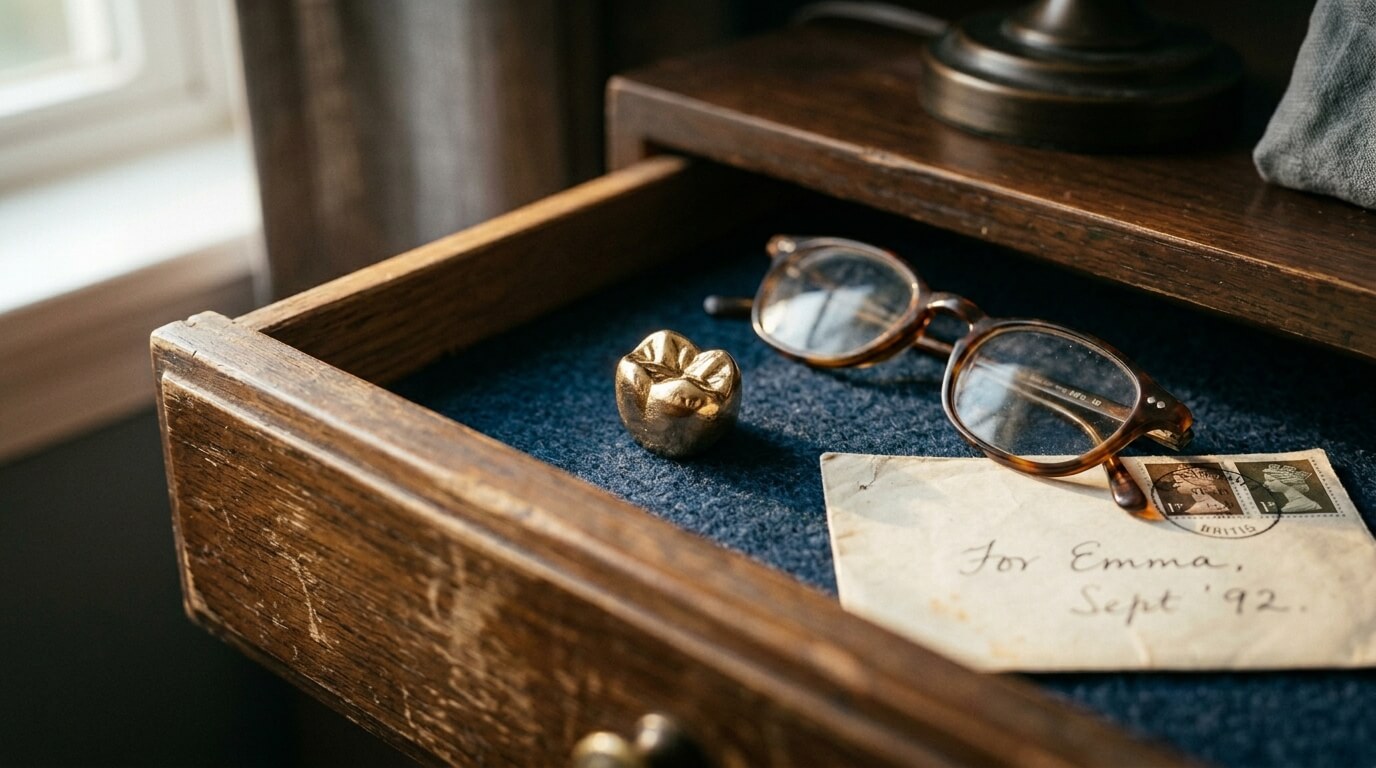
Somewhere in a bathroom drawer, a sandwich bag, or a small envelope tucked inside a nightstand, there’s a good chance you have money sitting around that you don’t know about. Maybe your dentist handed you an old crown after replacing it. Maybe a family member passed away and you found some dental work in their belongings. Maybe you just had a bridge removed and the dental office asked if you wanted to keep it.
Most people say yes, toss it in a drawer, and forget about it. A lot of people say no and let the dentist throw it away. Either way, they’re making a decision about something worth $50 to $200 or more per piece without even realizing it.
Dental gold is one of the most consistently undervalued items I see in almost 20 years of buying precious metals. At Bay Area Gold & Silver Buyers, we buy dental gold regularly at both our San Francisco and Houston locations, and the reaction is almost always the same: “Wait, that’s actually worth something?”
Yes. It’s worth quite a lot, actually. Let me explain why.
Why dentists use gold in the first place
Gold has been used in dentistry for over 2,500 years. There are records of gold dental work in ancient Egyptian remains. The reason is straightforward: gold is biocompatible, meaning the human body tolerates it extremely well. It doesn’t corrode in your mouth, doesn’t cause allergic reactions in most people, and doesn’t break down from constant exposure to saliva, food acids, and temperature changes.
Gold is also softer than tooth enamel, which means a gold crown won’t wear down the teeth around it the way some harder materials can. It’s malleable enough to form a precise fit against the tooth underneath. And it lasts. Gold dental restorations can survive 20, 30, even 40 years without failing.
Modern dentistry has shifted heavily toward tooth-colored materials like porcelain and ceramic. Patients want restorations that look natural, which makes sense. But gold is still considered one of the most durable options for molars and areas that take heavy chewing force. Plenty of dentists will tell you privately that gold is still the superior material for longevity. It just fell out of fashion because people don’t want visible metal when they smile.
The result is that millions of gold crowns, bridges, inlays, and onlays have been placed over the decades, and they’re steadily coming out as people get replacement work done or pass away. That gold has to go somewhere. Too often, it goes in the trash.
What karat is dental gold?
This is the part that surprises people. Dental gold is typically higher purity than most jewelry.
Standard gold jewelry in the US is usually 10K or 14K. That’s 41.7% and 58.3% pure gold respectively. Dental gold alloys generally range from about 16K to 22K, which works out to roughly 62% to 91% pure gold. Some dental gold alloys are even higher.
The reason for the higher purity goes back to biocompatibility. The more gold in the alloy, the less likely it is to cause any reaction in the mouth. Dental alloys also contain other noble metals like palladium, platinum, and silver, which are themselves valuable. So when we test a dental crown with our Niton XRF analyzer, we’re often seeing gold content plus other precious metals that add to the value.
Not all dental restorations contain gold, of course. Some are made from base metal alloys (often nickel-chromium or cobalt-chromium) that look silvery and have little precious metal value. Some are all-ceramic with no metal at all. And some are a gold alloy substructure with porcelain fused over the top, which is called PFM (porcelain-fused-to-metal). The PFM pieces still have gold in them. The porcelain portion doesn’t affect the gold value since we’re paying for the metal content by weight.
What is dental gold actually worth?
Let me run through some real math. Gold is trading around $4,300 to $4,400 per ounce in early 2026.
A single dental crown typically weighs between 2 and 5 grams, depending on the size of the tooth and how much gold was used. Some bridges connecting multiple teeth can weigh 10 grams or more.
Let’s take a common example: a gold crown weighing 3 grams at 18K purity (75% gold).
The pure gold content is 3 grams times 0.75, which equals 2.25 grams of pure gold. At $4,400 per troy ounce (and there are 31.1 grams in a troy ounce), the gold price per gram is about $141. So 2.25 grams of pure gold works out to roughly $318 in gold content alone. Add in any palladium or platinum in the alloy, and the value could be a bit higher.
A heavier crown at 5 grams and 20K purity? That’s 4.17 grams of pure gold, or about $588 in gold content.
A bridge with three or four units weighing 12 grams at 16K? That’s 8 grams of pure gold, roughly $1,128.
These are not trivial numbers. And they’ve roughly tripled in the last five years as gold prices climbed from around $1,500 per ounce to over $4,000.
Now, a buyer won’t pay you the full spot value. There’s always a margin because the metal needs to be refined and processed. But a good buyer who works directly with a refinery, like we do, can pay a significantly higher percentage than a buyer who has to sell to a middleman. That’s one of the things that sets us apart. We melt down and process the metal ourselves and deal directly with the refinery, so the margin that would normally go to a third party gets passed along to the customer instead.
Why do people throw dental gold away?
I’ve thought about this a lot over the years, and I think it comes down to a few things.
First, it doesn’t look valuable. A used dental crown is not a pretty object. It’s small, it might have cement or tooth material stuck to it, and it just looks like medical waste. Nothing about its appearance says “this is worth $200.” It looks like something that belongs in a biohazard bin.
Second, people don’t know dental alloys contain gold. Unless the crown is visibly gold-colored, people might assume it’s some kind of stainless steel or base metal. Even the gold-colored ones get dismissed because people think, “They wouldn’t put real gold in a tooth, would they?” They would. They did. For decades.
Third, dental offices don’t always tell patients what the removed work is worth. When a dentist takes out an old crown and asks, “Do you want to keep this?”, most patients hear that as a question about sentimentality, not value. The dentist isn’t trying to be deceptive. They’re focused on the procedure, not on helping you sell scrap metal. But the result is that a lot of gold literally gets thrown away at dental offices or ends up in medical waste disposal.
I’ve had clients bring in dental gold they found in a deceased parent’s belongings. They almost threw the entire bag away. One woman found a small container in her father’s medicine cabinet with four old crowns in it. She brought them in almost as an afterthought, tacked on to a bag of old jewelry she was selling. Those four crowns tested at 18K and 20K, and the total weight was just over 14 grams. We paid her over $900 for dental work she nearly dropped in the trash.
How to handle dental gold if you have it
If you have dental gold, whether from your own dental work or from a family member’s belongings, here’s what to do.
Don’t worry about cleaning it. You don’t need to remove cement or polish it. We test and weigh it as-is. Some people feel awkward bringing in something that was in someone’s mouth. That’s completely normal, but it’s also completely fine. We handle dental gold all the time and it doesn’t bother us at all.
Collect everything you have. If you’ve had multiple crowns or bridges removed over the years, gather them all up. Even a single small crown is worth bringing in. And if you find dental gold in a relative’s estate, check everywhere: bathroom drawers, medicine cabinets, small jewelry boxes, envelopes, film canisters (older people often stored small items in those).
Don’t try to determine the karat yourself. Unlike jewelry, dental gold usually doesn’t have a karat stamp on it. The only way to know the purity is to test it with professional equipment. Our Niton XRF analyzer reads the exact composition in about 30 seconds, right in front of you.
Bring it to a dedicated precious metals buyer, not a pawn shop. Pawn shops deal in a huge range of items and precious metals is just one small piece of their business. A dedicated buyer like us tests dental gold specifically and knows how to evaluate the full precious metal content, including palladium and platinum, not just the gold. That usually means a higher offer.
And as I always say, get more than one quote. We encourage customers to shop around. Visit two or three buyers, compare offers, and go with whoever treats you best and pays the most. We’re confident enough in our pricing to tell you that because we know what happens: people shop around and come back to us.
A note about estate situations
I want to specifically address this because it comes up frequently. When a family member passes away, especially an older person, their belongings may include dental gold that’s easy to miss. Older generations were more likely to have had gold dental work, and some of them saved their old crowns and bridges intentionally because they knew the gold had value.
Check small containers, pill bottles, jewelry boxes, desk drawers, and anywhere else small personal items might be stored. I’ve heard stories of people finding dental gold inside mint tins, film canisters, tackle boxes, and even tucked inside old wallets.
If you’re dealing with a larger estate and want privacy, we offer confidential consultations for estate evaluations. We’ve had the privilege of serving some of the most prestigious estates in the Bay Area, and our team can come to you if needed. We’ll go through everything piece by piece, including dental gold, jewelry, coins, and bullion, and give you a clear picture of what it’s all worth. The evaluation is free and there’s zero obligation.
We also work with estate attorneys who refer their clients to us. If you’re an attorney or executor handling an estate that includes precious metals or dental gold, feel free to reach out to discuss how we can help.
The bigger picture on dental gold
Dental gold is a small but consistent part of our business at Bay Area Gold & Silver Buyers. I’d estimate that at least a few customers per week bring in dental gold, either on its own or mixed in with other items. Almost every single one of them is surprised by what it’s worth.
With gold above $4,000 per ounce, the value of dental gold has never been higher. JP Morgan is forecasting gold could reach $5,000 by the end of 2026, and Goldman Sachs has a $6,000 target for 2027. If those projections hold, the dental crown sitting in your bathroom drawer is only going to get more valuable.
But there’s also the argument for selling now. Prices are already at historical highs. Nobody can time the market perfectly. If you have dental gold you’re never going to use for anything, the current price levels represent an excellent time to convert it to cash. Or a check, rather. We pay by check, not cash, which is something people sometimes ask about.
Our San Francisco location is at 780 Sutter Street in the Union Square area. Our Houston location is at 2635 Gessner Road, managed by Andre. Both locations are open Monday through Saturday, 10 AM to 5 PM. Walk-ins are welcome, or book an appointment online for faster service.
Bring your dental gold in. Bring everything. Even the piece you’re sure is worthless. We’ll test it in front of you, explain exactly what it is and what it’s worth, and make an offer. If you’re happy, we pay you on the spot. If not, you walk out with your items. No pressure, no hassle.
Just please, whatever you do, don’t throw it away.